What Makes a Leader? A Data-Driven Framework for Impact and Legacy

Idle curiosity again. Nerdiness for history again. And again a new found fascination for Gen AI tools. This time I tried my hand at evaluating Leadership. Not business leaders or CEOs – but emperors , leaders of countries and reformers and dictators.

Across centuries and across continents.

What makes a leader truly impactful? And what helps leaders leave a legacy?

Can we build a diagnostic model basis observable traits?

And how can Gen AI help?

Objectives

– Define a leader’s short-term impact and long-term legacy.
– Identify measurable inputs that contribute to leadership outcomes.
– Normalize across era, geography, governance type, and ideology.
– Build a predictive and diagnostic framework.
– Test the model on a cohort of diverse historical leaders.

Challenges

The task was complex. Leadership is not a universal currency. What counts as success for a 13th-century nomadic warlord may be the opposite of success for a 20th-century democrat. We had to avoid moral contamination, category bleed, and modern-day bias—while retaining judgment grounded in observable consequence. We refined, retested, and repeatedly stress-tested our framework using a mix of logic, historical context, and rigorous modeling.

Our Methodology

We eventually defined two outcome variables:
– Impact: Tangible, near-to-mid-term results achieved during the leader’s lifetime. Value-neutral.
– Legacy: Long-term influence, moral judgment, and remembered significance. More value-laden.

Then, we defined six input variables—Vision, Executional Efficacy, Resilience, Charisma & Influence, Ethical Governance, and Human Development Focus—each with structured subcategories. We scored each leader in the dataset across all categories.

This is what each of the input  variables mean :

Vision – is the ability to articulate a coherent vision. This is not necessarily about a ‘Grand’ vision or ‘Big’ ideas . This is about coherence , the ability to predict future trends , long term planning and  importantly the ability to communicate these ideas.

Executional Efficacy – the ability to deliver results despite structural issues , the ability to overcome hurdles. Ofcourse clearer the vision the better it gets for execution.

Resilience – the will and personal endurance to carry on despite setbacks.

Charisma – the emotional impact on followers , propaganda and mythmaking.

Ethical Governance – now this is interesting. This is essentially tolerance for dissent , ‘consultative’ness , protection of vulnerable groups. In many ways , this indicates the leader’s willingness or ability to build lasting institutions.

Human Development focus: as the name suggests how did said leader improve standards of living. As an extension how did he or she ‘develop’ their people .

It was important to overcome modern day biases while ranking leaders on Input variables. I could not let our moral values define how we view leaders during that time. For example , we did not penalize Churchill for being an imperialist – it was a fault of his times.

Similarly , I had to overcome ‘hindsight’ bias. So ,we rewarded or penalized leaders basis their decision making using the best possible information available during their time.

I also had to normalize for monarchies vs modern states. I did not penalize a monarch for ‘centralization’ but rewarded him if he was ‘consultative’. Similarly , I did not reward leaders in a democratic set up for being consultative but penalized them if they trampled on democratic norms.

Each of the input variables was a point system – reward and penalties. For example , in Vision Churchill was rewarded for anticipating the Hitler threat but penalized for his inability to predict the post war world order.

In Ethical Governance – Nehru was rewarded for his institution building but penalized for the first emergency in a state in India (Kerala) and his indifference to corruption in the Congress party.

Testing the Model

We then tested the model with a fixed cohort of 11 leaders, including Churchill, Nehru, Deng Xiaoping, Genghis Khan, Akbar, Atatürk, and others. We added more leaders for stress tests—like Lincoln, Catherine the Great, and Napoleon—using a ‘reverse test’: predicting outcome scores from inputs alone, then comparing against actual outcome evaluations.

We took out correlations for Impact and Legacy separately with each of the input variables. Here is how they look:

Input CategoryCorrelation with Impact
Executional Efficacy0.73
Vision & Clarity0.65
Resilience0.61
Human Development0.47
Charisma & Influence0.43
Ethical Governance-0.22

Interestingly in order to create short impact – execution efficacy seems the most important with clarity of vision and resilience being close. Ethical governance doesn’t seem to matter for short term impact too much.

The correlations for Legacy however were very different:

Input CategoryCorrelation with Legacy
Human Development Focus0.76
Vision and Clarity of Thought0.72
Executional Efficacy0.68
Ethical Governance0.63
Resilience0.54
Charisma and Influence0.51

Key Insights

The most predictive input for Impact was Executional Efficacy. For Legacy, Ethical Governance and Human Development emerged stronger.
We learned that:
– Vision matters, but only if it’s translated into reality.
– Ethical leaders don’t always have the highest short-term impact, but they often shape lasting legacies.
– People tend to forgive ‘strongman’ flaws in pursuit of results, but legacies demand fairness and systems.

Hitler for example had a very powerful impact during his time but his legacy has been dark. He had a coherent vision. We may not like it , yet it was a well articulated coherent vision. He had fantastic charisma , resilience and great execution abilities. All of this helped him create a great impact. In fact he is among the top in Impact. However , he is the bottom most in Legacy – being the bottom most in both Ethical Governance and Human Development.

Abraham Lincoln seems to emerge as the all round star – with consistently high rankings on both input and output.

Deng XiaoPing also does well in most categories – both input and output -except in Charisma and Ethical Governance.

Genghis Khan has the highest score in Impact and the highest score in Execution ,while his vision was very limited – he has middling scores in vision. It was not a grand vision yet it had coherence enough for tribal leaders to follow him.

Nehru scores high on vision , but middling scores in all the other input and output variables.

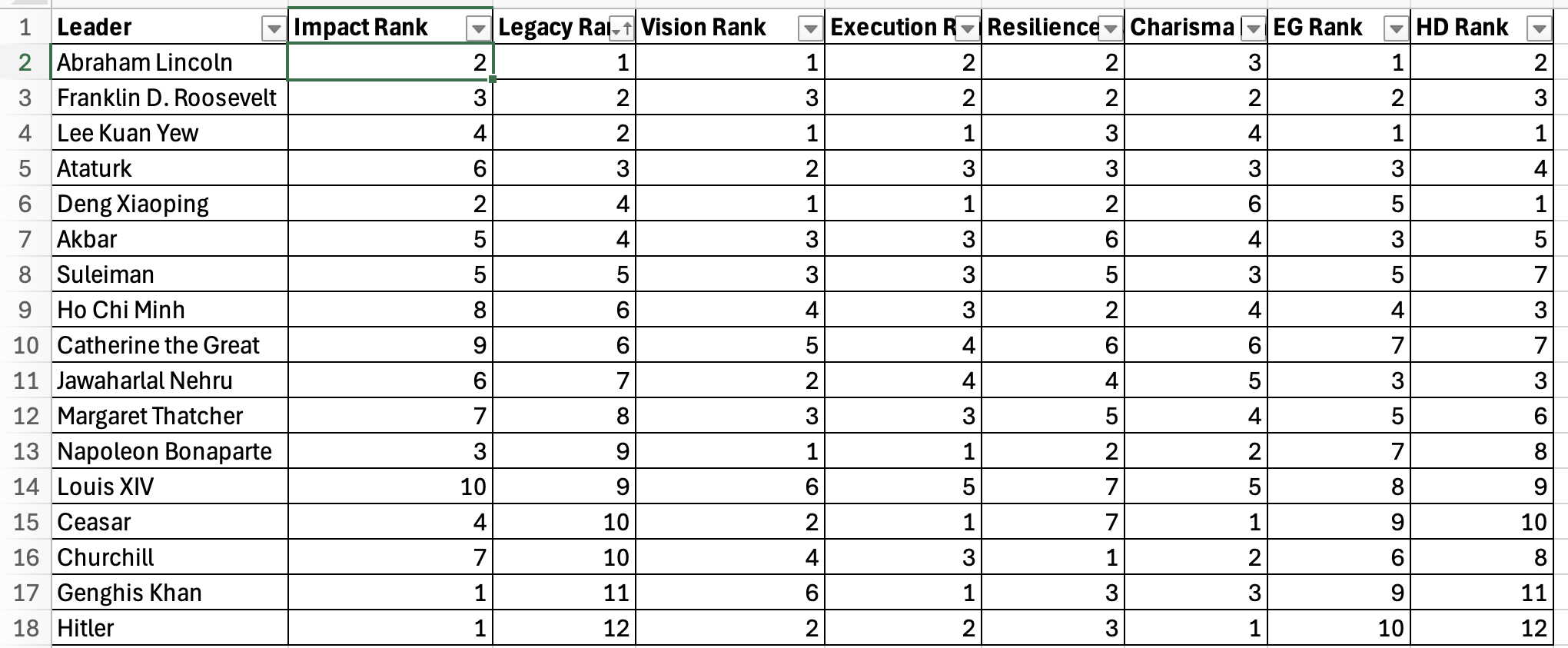
The below is the table of ranks:

Also the rankings are NOT comparisons between leaders. They operated in widely different contexts. They are just a way to aggregate and rank them basis their scores.
The Role of GenAI

This project was co-created with Generative AI. The human provided direction, historical insight, and iterative corrections. The AI enabled rigorous structure, memory, and hypothesis testing at scale. Neither alone would have sufficed. Together, we built something both rigorous and—perhaps—useful. However , it was a long chat. And by the end Chat Gpt had started massively hallucinating.

Final Reflections

This is not an academic exercise. Nor is it rigorous. It is interesting though. I don’t claim to have answered the question of leadership fully. But I have offered a way to structure it—one that blends history, analytics, and AI to illuminate what makes certain leaders resonate across time. This is a living model, and I invite comments and critiques.

Empire: A Data-Driven Thought Experiment

This didn’t begin as a project . Just idle curiosity and a vague question— the kind that gets you going – if you’re both a history nerd and newly curious about the capabilities of Generative AI.The question was simply this:  How do you compare the achievements of history’s great empires, fairly? Not just by size or fame, but by what they accomplished given their time, tools, and constraints.
So I teamed up with ChatGPT — as assistant, not author — and began building a framework.
This post outlines that framework, the metrics we used, the rankings that emerged, and the questions it raises about both past power and present perspectives. It’s  structured curiosity, not a sweeping claim. A little nerdy, hopefully thoughtful, and definitely open to debate.Also , this is no way romanticizes or condones imperialism and the undesirable consequences that imperialism has had on various peoples over the centuries. I do think it belongs to a dark chapter of our collective history.

1. Choosing Empires

I used two simple criteria to shortlist empires . Choose empires post 1 BCE and choose empires which spanned at least two continents.

Here is the list:

EmpireContinental SpreadTime Period
Roman
British
Ottoman
Mongol
Russian
Umayyad
Alexander

Sources: Britannica, World History Atlas. Criterion: Continental spread at peak, post-1 BC

The first question sounded deceptively simplistic :

Who expanded the fastest? However ,  consider two empires A and B . If A conquered a million sq. kms in 10 years but only had horses at their disposal vs B which also conquered a million sq. kms in the same period of time but had railways at their disposal – A ranks higher. I think that is only fair.

Now you could add on further nuance to it. What if both A and B conquer x sq.kms and A does it faster with horses and B does it slower with railways. A needs to get a further bump.

Means of transport also dictate speed of communication. And communication becomes important not only during war and for conquering territories but also to maintain conquered territories. You can come up with several such combinations. And clearly we need a metric that can normalize for this. And the below is what we came up with:

Key MetricRationale
Achievement per Unit of Speed

Sources: Comparative history frameworks, e.g. Ferguson, Diamond, Toynbee.

We also examined each empire’s fastest available transport and communication systems — from Roman roads and Mongol Yam relays to British steamships and then ranked them on a relative , simple 1-10 scale.

Refer to the table below. The Romans had great roads , yet they were amongst the slowest. Alexander and the Russians rank slightly above the Romans. The British had the best speeds.

EmpirePrimary TransportRelative Speed (1–10)
RomanRoad Network5
BritishSteamships/Rail9
OttomanCaravan + Sea6
MongolHorse Relay (Yam)8
RussianSledges, Rail (late)6
UmayyadCamel Caravan5
AlexanderHorse, Foot6

Sources: UNESCO Silk Road Programme, Transport History encyclopedias

2.. Expansion Efficiency

Now it was important to evaluate expansion efficiencies. Like I said above , one cannot take the area conquered as the sole reliable indicator. One needs to look at this in the context of the both the fastest means of transport available as also the time it took to reach the peak conquered area. We calculated a metric based on land area × continental spread ÷ years to peak. This revealed which empires expanded quickly and widely given their constraints.Refer to the table below to see this in action. Alexander scores the best. At his peak he had conquered almost a similar area like the Ottomans in 10th the time it took the Ottomans . And in relative speed , the ottomans and Alexander rank the same.

The Mongols are second . The Russians and the Ottomans fare the worst here.

EmpireArea at Peak (sq km)Years to PeakExpansion Index
Ottoman5.2M1300.40
British35.5M1800.54
Roman5.0M2000.25
Mongol24.0M541.00
Umayyad11.1M890.69
Alexander5.2M131.15
Russian22.8M2000.34

Sources: Historical atlases, peer-reviewed geography datasets.

3. Geographic & Cultural Adaptability

Then we ranked empires on their ‘adaptability’. How many different climates did they have to operate in? What levels of cultural and religious variability did they to contend with? And how well did they integrate ? Empires were scored on how well they adapted to unfamiliar climates, languages, and cultures. Homogeneity wasn’t rewarded; integration was.

Interestingly , the Russians again score the lowest – they were a vast empire – but perhaps not much diversity. The Ottomans score the best , followed by the Romans.

EmpireAdaptability Score (1–10)
Ottoman8
British6
Roman7
Mongol5
Umayyad6
Russian4
Alexander6

Sources: Scored based on geographic variance + cultural integration ability.

4. Diversity in Governance

The next natural question was , how did they integrate the new peoples into their governing mechanisms.? How tolerant were they? Did they suppress or did they integrate? Measured. Ottoman millet system scored well — but devshirme was penalized.

The Ottomans and the Romans come out on top here too.

EmpireDiversity Governance Score (1–10)
Ottoman7
British6
Roman7
Mongol5
Umayyad6
Russian4
Alexander5

Sources: Cambridge History of Islam, Roman legal systems, colonial records.

5. Benevolence Index

Next we looked at ‘Benevolence’. How exploitative were each of the empires? Did they persecute? Did they give local autonomy? Were their taxations systems draconian?

Please note that there is a lot of subjectivity involved in this question. Interestingly , the Ottomans and the Romans come out on top again.

This heavily weighted metric penalized extractive, brutal rule.

EmpireBenevolence Score (1–10)
Ottoman7
British5
Roman6
Mongol3
Umayyad5
Russian3
Alexander4

Sources: Evaluated based on taxation, persecution, local autonomy.

6. Legacy Index

Then we evaluated ‘legacy’- what lasting achievements did each of these empires leave? In law , education and government? These results should not be very suprising.

EmpireLegacy Score (1–10)
Roman9
British8
Ottoman7
Mongol4
Umayyad6
Russian5
Alexander5

Sources: Measured legal, educational, and cultural contributions.

7. Decline Dynamics

Then we assessed decline dynamics. If an empire declined over a longer period of time – we considered it to be more robust. We also took into account the preventability of the decline factors. For example , freedom movements are not preventable , where as corruption and lack of reform are.

Interestingly enough , the Ottomans score the highest in preventability score. Both them and the Romans had a very long , very painful decline.

EmpireYears from Peak to FallPreventability Score (1–10)
Ottoman2507
British606
Roman3005
Mongol1003
Umayyad893
Russian754
Alexander101

Sources: Reform readiness and internal dynamics literature.

8. Composite Ranking

All individual metrics were normalized (0–1 scale), with higher weights on benevolence and legacy.

Finally each of these metrics were normalized on a 0-1 scale and then weighted with benevolence and legacy together accounting for 60% of the weightages.

Here is the final table. I have always been fascinated with the Ottomans -not really sure why. I was surprised though to see them topping the chart.

EmpireComposite ScoreRankConfidence Band
Ottoman0.89🥇 1stHigh
British0.84🥈 2ndMedium-High
Roman0.80🥉 3rdMedium
Umayyad0.754thMedium
Alexander0.725thMedium-Low
Mongol0.686thMedium-Low
Russian0.657thLow

Confidence band reflects documentation consistency and metric stability.

Final thoughts: This is no way an acedamecially rigorus work . There are error margins and the confidence levels are not uniformly high.

However , I do think it is an interesting exercise – not only in terms of taking a fresh lens to empires , but also how do we use powerful tools to ask the right questions.

Would love your thoughts.

INSANITY

It is but yet another random point in Space- Time,

With no meaning in and of itself,

Yet I look upon it with all the reverence due to a magical portal

The moment signifies naught but yet another revolution of the Pale Blue Dot

Around an insignificant star at a forgotten edge of the cosmos

Yet I look upon this moment like it could herald revolutions

The heavens have gone on for eons and will continue for eons to come

Beautiful, cold and indifferent

Dancing their way through time – reckoning it on a scale that is beyond me

Yet I want to believe that this particular moment is as special to the cosmos as it is to me

I call it the Future , I think it is yet to happen and I look forward to it

The cold , distant stars laugh at me , “But it has already happened , we know , we have seen it”  , they say,  but wont tell me anything more

I look down, unable to bear the coldness of the Heavens

And I look back at what I call my Past

I survey the debris and the rubble from years Past

Promises – broken, unkept and unrealized

Ideas – half baked, half-forgotten and half realized

Unread pages, unwritten stories , unwanted troubles

Dark despair and unbearable stillness

I am going to carry all of this Debris to the so-called Future

Through a magical portal that is not magical

And expect this Debris to magically transform into architectural wonders

I expect revolutions where none are in the offing,

I expect the Cold Cosmos to share in my view of the Future

I am stung by The Indifference of the Heavens

I am depressed by The Debris of the Past

And I am afraid that the Future has already happened

Yet I find myself looking forward to another Year

Insanity? , perhaps , but it helps me survive.

IF ONLY

It would all have been easier, easier to bear, easier to live with 

I am tired, nay, I am weary , weary to my very marrow 

Weary of these Sisyphean ordeals 

Farcical déjà vu s , playing in loops , again and again and again 

With nary an alteration 

I am weary , I hurt , my shoulders sag and my insides burn 

It would all have been easier , easier to bear , easier to live with 

If only I was numb 

I would have expected the numbness to have settled in by now 

The weariness should have made me numb by now, numb and inert 

To the ordeals and to the pain 

But somehow I still feel the pain as keenly as I used to 

I still hope as fervently as I used to 

Scars from wounds long ago still throb and hurt 

As much as yesterday’s bruise 

Long buried memories of rainbows still intrude to make me smile 

As much as yesterday’s silver lining 

I still sob and wail as much as I used to 

And laugh and rejoice too 

I still feel too keenly and hope too fervently 

Despite the weariness and despite the hurt 

I know that that is all that there is 

Yet I still drink too deeply from Hope’s poisoned Chalice 

Prolonging Life and hastening Death 

It would all have been easier , easier to bear , easier to live with 

If only I was numb

APPEALING TO BETTER NATURE

The years 1940 and 1941. It was ,in many senses , Hitler’s world. He had almost the entire of continental Europe under his boot. A couple of years earlier , Austria was annexed. Then came Czechoslovakia’s turn. Poland was next in 1939- the year we usually associate with the beginning of the second world war. Denmark and Norway fell soon afterwards to German aggression , followed by France. Hitler achieved all of these feats with surprising ease and felicity. Then there was the battle of Dunkirk in 1941. For all the courage and fortitude that the British troops displayed – they had received a drubbing and a bad one at that. It is said that had Hitler pressed his advantage at this stage-he could have achieved further gains. The reasons as to why he did not are not very clear. Germany had a pact with Soviet Union – albeit an uneasy one. The two powers and the two dictators didn’t really trust each other. The United States was determined to be neutral.

The point is , again , it was Hitler’s world. Only one European country openly stood against Germany – the United Kingdom. While boasting of great airpower and a navy , they had no army to speak of and the battle of Dunkirk had further depleted them. Compared to the German war machine – at that stage of the war – the Britishers were savages with spears.

Yet the UK chose to stand against Germany. Hitler was ready to sign a pact with the Britishers. Defending and feeding a small island nation in peace time is an achievement. The island nation had always depended on its mercantile routes to feed itself. Doing so in a hostile world is monumental. Choosing to do so , when there were easier options available was courageous (or foolhardy as was also one of the prevalent opinions in those days). The UK could have played a part in truly making it Hitler’s world. It chose not to.

And one of the key driving figures behind this was Winston Churchill. I balk at the “Great Man/Woman theory of history”. There are many complex forces that shape history for us to attribute it’s course to a few men/women. However, leaders do play a part in shaping events. And Churchill was a key player.

Imagine yourself to be the leader of a beleaguered nation. Your people are suffering privations because of the war. You don’t have the military wherewithal (yet) to face the enemy. You have no help forthcoming. Your allies have surrendered. Your friends are neutral. You could have taken the peace pact. You do have an easy way out. Yet you chose not to. And you convince your people why you should not. You convince them why you should fight this out and not capitulate. You ride it out. And as times get better and circumstances start favoring you , you play a key part in winning the war.

More than winning the war – it is the holding out that is impressive. This was truly the ‘darkest hour’ as Churchill himself says. That you chose to take a stand when you had an easy way out  is impressive. Needs conviction. And moral courage. And in many ways Churchill had that. To be sure Churchill had many faults. He was an imperialist and we today would term him racist. He was deeply flawed. We would be right in judging him harshly for them -but we will also do well to remember that they were also the flaws of his times. Leaders, even Statesmen are flawed and deeply so. We should make our peace with that. We will also be naïve to ignore the practical reasons behind this stand. But neither the flaws nor the reasons take away the sheen form his stewardship in those troubled times.

And Churchill’s stewardship stands in stark contrast to Hitler’s , despite ‘surfacy’ similarities. Hitler also had conviction. He stood alone in the initial days of the war in his pursuit of world conquering superiority. It was only the surprisingly easy initial successes that rallied his Generals around him. And he did convert an entire German people to his cause. He also appealed to their national pride. Both Churchill and Hitler were great orators. If we remember only Churchill’s perorations now, it is perhaps because of the dominance of English in the modern world order. But the similarities end here.

Hitler appealed to the ‘basest’ instincts of his people. He reminded them of previous humiliations. He told them they were ‘superior’ to every race. In doing so he appealed to their inferiority complex. He inspired a fear of the other and told them they needed to hate in order to win. That everybody was out to get them. He did rally the German people but may be the average German citizen’s psyche at that time was not particularly healthy. They were motivated and fully behind Hitler (with a few honorable exceptions) , but their base instincts ruled.

In contrast , Churchill perhaps appealed to the better nature of the Britishers. He did appeal to national pride. He did tell them how they stood alone in a world that was increasingly turning bleaker and darker. Yet he also appealed to their love of freedom and of liberty. He did tell them they had to save the world , but for better reasons. He didn’t tell his people , unlike Hitler , that they were a long suffering race. He didn’t tell them they were superior to everyone else , appeals to national pride notwithstanding. He didn’t tell them they need to conquer the world to feel better.

It is an interesting contrast. Particularly if we remember that Germans were almost victorious and for all practical purposes looking at a bright future. and the Britishers were beleaguered and looking to a rather uncertain future.

And Churchill achieved this in a democracy. Hitler was a dictator (despite the show of democracy).

Events could have very well turned out differently. Hitler could have achieved his ambitions. And I would have been writing this in German glorifying Hitler’s leadership. Historical progress is far too complex to be pinned down to a few people and few events.

Yet there is merit in taking a note of this.

It is a very interesting contrast of what leaders chose to appeal to in their people. Appealing to base instincts is easier and gives quick dividends.

Appealing to their better nature is definitely more difficult.

But there is something definitely worthwhile about it.

KNAPSACK

It was the end of the road , I had scaled another peak 

I was weary so I sat down and emptied my knapsack on the side of the road 

I hadn’t looked at it’s contents in a long while , 

I am a collector ,all of my valuables and my winnings were in the knapsack  

I was eager and excited , I had so much to show for my difficult trek up the mountain 

So I empty it and go through it’s contents 

I surprised myself by feeling a twinge of disappointment and of sadness 

Why do my trophies look like mere baubles? 

Why do my winnings look like mere trinkets? 

I had collected many pieces of silver , why is their shine so dull? 

I searched my memory , why is it so hazy? 

When I was fighting for those trophies, they seemed so important , so shiny 

Everyone around seemed to agree , they clapped and cheered me on didn’t they? 

They appear as mere baubles now , so I threw them away 

I turn to my winnings now and my many pieces of silver 

I remember the many casinos and markets along the trek 

Where I had gambled away my time and many pieces of my soul 

Just so I could win these – they seemed so shiny then – the pieces of silver and my many winnings 

I remember wanting them , so badly 

Now they appear lusterless , so I threw them away 

I searched myself , I looked for my soul 

It was riddled through with holes , I had been breaking pieces of it to gamble away 

It seemed easier that way coming up , lighter 

I looked at my watch , I didn’t have too much time left 

I had spent too much of it winning baubles and trinkets 

I sighed 

This has been yet another all too familiar experience 

Another false peak , another knapsack that I threw away 

I get up with difficulty , groaning and weary , searching the horizon 

I spy another peak 

May be this will be the one 

I have some time left , however little 

I have still parts of my soul left to gamble away 

May be I wont have to throw away the knapsack after scaling this one 

I hope this will be the last 

I haven’t time nor much of a soul left 


THE MAZE

I stumble though life, mostly -nay- always clueless 

Many metaphors come to mind , but none as apt as the Maze , 

A Maze with no design and no purpose , A maze that just is 

One day I was dropped in the middle of it ,and I have been stumbling through ever since 

I have met many people in the maze , some  full of purpose , many listless

Some claim to have solved the maze , some say it is futile even to try 

Some say it loops upon itself this maze , some say there is a definite end 

Some say the maze is evil , some say the maze is the punishment for being evil 

There was a time when I wanted to solve the maze , I was sure there was a solution

I was full of vim and vigor , so I would always run

I was so sure of myself , so I would take paths at will 

Then I started running into dead ends , so I slowed down 

I would walk sometimes and I would think carefully at every branch of the path 

I still was running into dead ends 

I sought help , I talked to people along the way , I asked for directions 

Some of them shrugged and walked away 

Some were friendly and pointed in various directions 

I found maps and I prayed on my knees for guidance 

There were moments of rare if false clarity ,

When I thought the entire maze was bathed in clear , heavenly light 

And I could see beyond the maze 

But I would still run into dead ends 

I am tired now and weary to the bone  

I neither run nor walk nor amble , I only stumble 

I was always clueless and now I am listless too 

I am not sure if I care anymore 

I take paths at will , because I think it doesn’t matter anymore 

I stop at will , and keep gawking at shiny objects along the way 

I still talk to other people , but never ask for directions now 

I still find maps along the way and I promptly tear them up 

I don’t remember the last time I prayed for guidance 

And I laugh at moments of clarity 

I stumble through the maze , hating it and yearning for a release 


THE PERFORMANCE

I have always been a performer , since I was young , ever since I remember 

Sometimes I am a clown , other times I am a dancer  

At times I am the brave leader , most of the times I am a meek follower 

I always remember my lines and deliver them to near perfection 

I always know what emotion to enact ,whether I really felt it or not is always immaterial 

I wear many masks and slip in and out of costumes 

Ever since I remember I have been on this stage 

The audience watches or I think they do , I only see vague outlines beyond the stage 

I think there are many , I hear murmurs , I hear conversations 

Once in a long while , I hear scattered applause 

It is the applause that spurs me on , I assume they are applauding for me 

I can only assume , for I see only vague outlines , but I know there are many of them 

Once -they applauded when I laughed dramatically , so I tried it again -it fell flat 

So I stopped laughing and sobbed and wept , this time there was applause 

But when I tried it again – it didn’t work 

Over a period of time , I have learnt that this unseen audience is fickle 

I have never understood what they like , so I have taken to try a great many different things 

Once I self immolated on stage , smelling my own burning flesh 

One other time , I peeled my skin off . I even gouged out my own eyes once 

Once I broke my leg and danced a jig 

And another time I tried telling jokes while repeatedly stabbing myself 

I don’t know what works anymore 

The applause gets more muted as the years pass on 

But I keep at it , I keep up the performance 

I am all burnt and scabbed skin now 

My voice is hoarse , I have lost a lung and I walk with a limp 

My mother keeps telling me to get off the stage , she begs , she screams , she pleads 

But she doesn’t understand 

The applause may spur me on , but I am not doing this for the unseen audience 

I am doing this for myself 

Or so I tell her. 

THE PUNISHMENT

I was punished by the Gods and the punishment was for Eternity 

I was to sit in a small room with a broken window and gaze out upon the world 

And just watch , watch all that passes on as life and watch all the lives that pass on 

Such was my lot , so every day I watch from my broken window and see a great many things 

And most of what I see , makes me sad 

I see hearses bearing Tiny Coffins ,wind their slow painful way down the road 

I see graveyards upon graveyards filled with the corpses of Unfulfilled Potential 

I see heart wrenching pangs of Unrequited Love 

I see Untold Stories braying in pain and running down the road begging to be completed

I see friends drifting apart for no reason and I see lovers who haven’t talked in a long while 

I see Impotent Anger and I am both disgusted and saddened 

I see relationships grow cool and indifferent and a little sob escapes from me 

I see people engaged in pointless waits for even they know not what 

I see mankind’s immense capacity for casual cruelty and unspeakable evil 

I wonder at the Silence of Good People and am terrified for the world 

I see Unresolved Conflict , I see Blind Faith , I see Broken Conversations and Lives Not Lived 

And I see this day after day , every day 

I have been seeing this for eternity and I am cursed to see this for an eternity more 

But once in a long while , the horizon clears 

And the Sun seems to shine , it seems to shine upon Vistas of Immeasurable beauty 

I seem to see Love , I seem to spy happiness , I seem to see lives fully lived , and stories all told 

They are very brief - these moments they don’t last long 

I am not even sure if they are real , may be I am just seeing what I want to see , what I long to see 

I am sure it is a trick  being played by the Gods 

They are giving me Hope , the Gods 

And Hope is the Gods’ cruelest punishment 

ONCE UPON A WORD

      There couldn’t have been humbler beginnings ..or messier ones 

      In a Primordial soup , it started it’s life , in a chaotic mess it all began 

      In unformed thoughts , in guttural groans and in inarticulate sounds 

      In gestures and in paintings on caves , in necessity and may be in desperation too 

      Into this mess , it was born …no one knows from whence it came or how

      It’s birth was not destined nor was it anticipated in any way ..

      One day it wasn’t and the next day it just was ..the first Word came into existence

      And then everything changed … the world would no longer be the same 

      The first Word was feeling lonely 

      So it dipped into the primordial soup and started creating more of it’s own kind

      And before time , there were many of them 

      And then they started creating other things and remaking the world 

      They were Gods really…so they started by creating Gods ..

      They invented War and then Diplomacy...they birthed Hatred 

      Then came Lust ….and closely on it’s heels , Love took form

      And the more they created ..the more powerful they became

     Thoughts were no longer unformed ..sounds were no longer inarticulate 

     Thoughts and sounds may have birthed Words ..

     But once formed , Words rebirthed Thoughts and sounds ..

     It is the weirdest cycle of life.. 

     They rule us now , these Words ..

     They are omnipotent …they can be empty and mean nothing 

     They can also mean the world …they hurt ..they soothe 

     They create ..they destroy ..they inspire. They deflate… 
     
     They are omniscient …they know everything ..

     And without them nothing can be known .. 

     They inform …they obfuscate…they confuse ..and they edify .. 

     They are shapeshifters ….they can be dense like a winter fog… 

     And clear as a spring morning…

    They are the medium and the message… 

    The beginning ..the end and the middle too..

    The world birthed them and they birthed whole new worlds.. 

    It is true what they say ..

    In the Beginning. There was the Word.. 

    But the Word was not with God..

    The Word was God.